Disclosure: This guide contains affiliate links. If you buy through them, BunyanSafe may earn a commission at no extra cost to you.
A carbon monoxide detector is a warning device, not a substitute for safe fuel-burning appliances, ventilation, or emergency action. Winter makes the choice more urgent because homes are closed up and furnaces, fireplaces, generators, and vehicles can create carbon-monoxide risk. This guide compares five current detector types and explains where the buying decision matters most.
We reviewed product-listing information available through approved affiliate tools and public guidance from CPSC and the U.S. Fire Administration. We did not hands-on test these alarms. Follow the exact product manual, local code, and qualified-installation advice for your home.
Quick picks: match the detector to the location
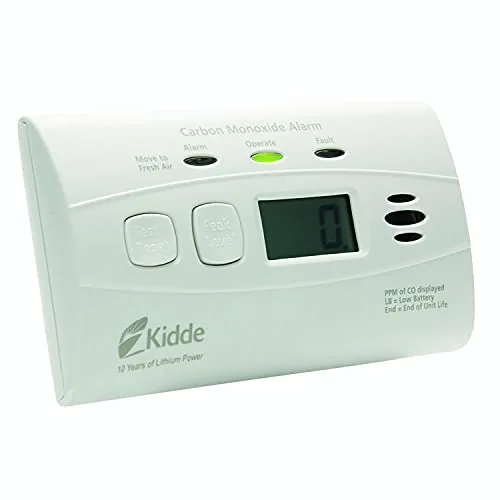
- Long-life battery option: Kidde 10-year battery detector with digital display—confirm its listed placement and replacement instructions.
- Outlet location with backup: Kidde plug-in detector with AA battery backup—confirm outlet location and manual requirements.
- Multiple rooms to cover: Heiman 3-pack low-level digital-display detectors—map every required location before choosing quantity.
- Hardwired renovation: A listed hardwired smoke-and-CO detector with 10-year backup—use a qualified installer and verify system compatibility.
- Another plug-in format: SITERWELL 10-year battery and AC-powered detector—compare its exact manual before ordering.
Where should carbon monoxide detectors go?
CPSC recommends carbon-monoxide alarms on every level of the home and outside each sleeping area. Start with a simple map: bedrooms, sleeping halls, basement, main living level, and any level with a fuel-burning appliance or attached garage. A detector only helps if its alarm can be heard and the device is placed according to its own manual.
Do not install by guessing. A plug-in model requires an appropriate outlet; a battery unit needs a location allowed by its instructions; and a hardwired model may require a compatible circuit and qualified installer. Placement can vary by unit, so use official public guidance for the home plan and the exact manual for final position.
Keep portable generators outdoors and well away from doors, windows, and vents. Never use a generator, charcoal grill, camp stove, or fuel-burning appliance intended for outdoors inside a home, garage, basement, or partially enclosed space. Read CPSC’s carbon-monoxide safety guidance before winter storms or any backup-power use.
Carbon monoxide detector comparison at a glance
| Model | Listing type to compare | Check first | Best next step |
|---|---|---|---|
| Kidde 10-year battery digital-display detector | Battery-powered CO detector | Manual placement and replacement date | Map each home level |
| Kidde plug-in detector with AA backup | Plug-in CO detector | Outlet and backup-battery instructions | Choose a suitable sleeping-area location |
| Heiman low-level display 3-pack | Multi-pack CO detector | Coverage plan and exact listing details | Count locations before purchase |
| Hardwired smoke + CO detector | Hardwired combination alarm | Wiring and interconnect compatibility | Use a qualified installer |
| SITERWELL AC-powered detector | Plug-in (AC-powered) CO detector | Exact manual and power requirements | Compare with the planned location |
1. Kidde 10-year battery carbon monoxide detector with digital display
Who it may suit: Someone comparing a listed battery-powered CO detector with a 10-year battery and digital display for a location where the manual permits battery operation. A self-contained detector can simplify a planned placement, but it does not reduce the number of required locations in a multi-level home.
Who this is not for: Anyone treating a 10-year battery as a reason not to test. Test the alarm as the manual directs and record its installation and replacement date.

- Electrochemical sensor technology detects CO gas & sounds an 85-decibel alarm
- Easy installation, no wiring needed: operates on a 10-year lithium battery, so it never needs replacing, plus detects du…
- Digital display updates every 15 seconds & displays the level of CO presence
Before choosing a single unit, count the levels and sleeping areas first. One detector is useful only when it is part of complete coverage.
2. Kidde plug-in carbon monoxide detector with AA battery backup
Who it may suit: A household with a suitable outlet near a planned CO-detector location that wants to compare a listed plug-in model with AA battery backup. Check that the outlet height, room, and nearby airflow fit the manufacturer’s directions.
Who this is not for: A location where the only available outlet is unsuitable or where a cord, furniture, or appliance would interfere with installation. Never stretch the plan to fit a product; choose a device appropriate to the required location.
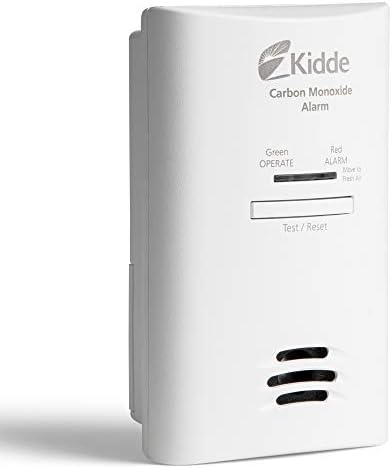
- Easy Installation – simply plug-in to a standard, 120V outlet in your home
- 2-AA battery backup provides protection during a power outage
- 85-decibel alarm announces when carbon monoxide is detected
Backup power deserves a practical check: follow the manual for battery type, replacement, and testing. Do not assume every plug-in detector behaves the same way during an outage.
3. Heiman low-level digital-display carbon monoxide detector 3-pack
Who it may suit: A buyer comparing a listed three-pack of low-level digital-display CO alarms for several planned locations. A multi-pack can make dates and routine checks easier to manage when each location genuinely needs a device.
Who this is not for: Anyone choosing quantity before making a home map. Three alarms may be too few or too many depending on home levels, sleeping areas, and local requirements.

- 10 Year Sealed Lithium Battery, No Replacement Needed — Equipped with a built-in 10-Year CR-2/3AZ lithium battery, this …
- UL 2034 5th Edition Certified & CSFM Approved — Meets strict UL 2034 5th Edition sensitivity and performance standards, …
- Real-Time LCD Display + Graded Low Level CO Early Warning System — This carbon monoxide detector features a clear digita…
Write the intended location beside each unit before opening packaging. That small step helps prevent a detector being left in a box while a sleeping area remains uncovered.
4. Hardwired smoke and carbon monoxide detector with 10-year backup
Who it may suit: A homeowner planning a permitted hardwired smoke-and-CO project and comparing a listing that describes hardwired power, a 10-year battery backup, and interconnection. It may fit a wider alarm-system discussion when the exact wiring and compatible models are confirmed first.
Who this is not for: A do-it-yourself wiring experiment. USFA advises using qualified electricians for hardwired alarm work. Ask the installer to confirm interconnect and code requirements before buying a group of devices.
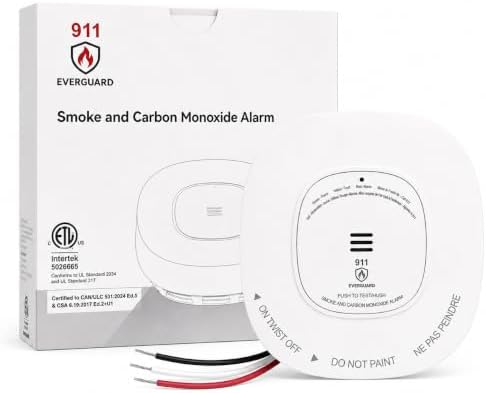
- ETL LISTED & CERTIFIED FOR SAFETY Independently tested and ETL Listed by Intertek (Control No. 5026665). Conforms to UL …
- 2-IN-1 SMOKE & CARBON MONOXIDE PROTECTION – Combination alarm provides photoelectric smoke detection and carbon monoxide…
- HARDWIRED 120V AC WITH 10-YEAR BATTERY BACKUP – Designed for hardwired residential installation with a sealed 10-year ba…
A combined smoke-and-CO unit can be useful in a correctly selected location, but it does not erase the need to plan both smoke and CO coverage throughout the home.
5. SITERWELL plug-in (AC-powered) carbon monoxide detector with listed 10-year battery
Who it may suit: A buyer comparing an AC-powered detector listing that includes a 10-year battery. Treat this as a model to verify against the manual: confirm power source, mounting, testing, and the exact location before purchase.
Who this is not for: Anyone relying on a search-listing headline alone. Carbon-monoxide alarms are safety devices, so the model manual and locally applicable requirements should settle the final choice.

- Carbon Monoxide Detectors
- 10 YEARS BATTERY: This CO alarm detector equipped with 10-year battery, the backup batteries ensure that the carbon mono…
- BREATHING LIGHT: Gentle light desian and one-touch silence function ensure your sleep won’t be disturbed. If the carbon-…
The sensible comparison is not “which detector has the longest feature list?” It is “which listed device fits this required location and can the household keep it tested?”
Black Friday tip: if you shop holiday sales for CO alarms, first check the maker’s replacement interval or end-of-life warning for any CO alarm you already own, and choose an alarm certified to UL 2034. Check the current price on Amazon. Buy for the locations you actually need to cover, such as every level and outside each sleeping area, not just the number of units in a deal pack.
Buying guide: battery, plug-in, or hardwired CO detector?
Battery-powered detectors can help cover locations where the model manual allows them. Their advantage is flexibility; their responsibility is a visible testing and replacement routine. A sealed long-life battery does not make a detector permanent.
Plug-in detectors can be convenient near an appropriate outlet, especially when a model includes a backup battery. Check the manual carefully because outlet location, clearance, and the room’s airflow can affect what is appropriate.
Hardwired and interconnected devices may be appropriate in a compatible electrical system. They require more planning, not less: confirm the existing wiring, connector, compatible models, battery-backup instructions, and local requirements before changing anything.
What carbon monoxide symptoms mean for your safety plan
CPSC lists headache, dizziness, weakness, nausea or vomiting, chest pain, and confusion among possible CO-poisoning symptoms. If a CO alarm sounds or you suspect exposure, get everyone to fresh air immediately and call 911 or local emergency services. Do not re-enter until emergency responders say it is safe.
A detector is an early-warning layer. It does not tell you which appliance caused the problem, and it does not make a suspected leak safe to investigate. Plan now: know the outside meeting point, make sure children and guests understand the alarm, and keep emergency numbers accessible.
Winter heating and garage mistakes to avoid
- Never warm up or run a vehicle in an attached garage, even when the garage door is open.
- Never use a generator, grill, camp stove, or charcoal indoors or in a garage.
- Keep portable generators outdoors and away from openings, following official distance guidance.
- Have fuel-burning appliances inspected and serviced by qualified professionals as recommended.
- Do not ignore repeated alarm signals, low-battery warnings, or an appliance that behaves unusually.
- Do not disable a CO detector because it is inconvenient or because you are unsure of the source.
A room-by-room CO-detector checklist
Walk the home with a note on your phone. Mark every level and each sleeping area. Then mark fuel-burning equipment, fireplaces, and the attached garage. This is not a substitute for code or a product manual; it is a way to ask the right questions before buying a random detector.
For each planned detector, record the power type, installation date, test routine, and expected replacement date. If your home has hardwired alarms, photograph the current model and connector before ordering replacements. That can save a purchase that does not fit the existing system.
How this fits your broader winter safety plan
If you are closing up the house for winter, it is also a good time to test for radon, another gas you cannot see or smell; our radon detector guide compares monitors and test kits.
Heating, alarms, and emergency readiness work together. Review our space heater safety guide before using supplemental heat, and use our smoke detector guide to map fire-warning coverage alongside CO locations. Keep the plans separate enough to follow each manual, but review them together before cold weather arrives.
Frequently asked questions
Do I need a carbon monoxide detector on every level?
CPSC recommends CO alarms on every level of the home and outside each sleeping area. Check local rules and the detector manual for your home’s final placement.
Where should I put a carbon monoxide detector?
Start outside sleeping areas and on every level, then follow the exact product manual for mounting and distance details. Do not place one by guesswork.
What should I do if my CO alarm sounds?
Move everyone to fresh air immediately and call 911 or local emergency services. Do not re-enter until responders say it is safe.
Can a smoke and CO combination alarm cover a whole home?
A combination unit may cover one correctly chosen location, but whole-home smoke and CO coverage still needs a location-by-location plan.
Should I test a carbon monoxide detector?
Yes. Follow the product manual’s testing instructions and keep a record of installation and replacement dates.
The safer carbon-monoxide-detector decision
Choose a carbon monoxide detector after mapping the home, not before. Cover every level and sleeping area, match each device to its intended location, follow the exact manual, and practice leaving immediately if an alarm sounds. The most valuable detector is the one that is correctly placed, working, and supported by a household emergency plan.