Last updated: November 1, 2026
Quick answer: For a plug-in radon detector you can leave running, the Ecosense RadonEye RD200 is our top pick: it earned A grades in all four rounds of Canada’s C-NRPP chamber comparison and gave Bob Vila’s testers a first reading in 10 minutes. For a battery monitor with no app, the Airthings Corentium Home also scored A in every round and is Bob Vila’s best overall. For a low-cost short-term check, the First Alert RD1 mail-in kit sends one sample to a lab; a high result needs a follow-up test.
Disclosure: As an Amazon Associate we earn from qualifying purchases, at no extra cost to you.
How we picked: We compared digital radon monitors and a mail-in test kit on Amazon US by sensor type, time to first reading, power, app and display, seller and rating counts, and checked stock for delivery to New York 10001 on November 1, 2026. We did not test these devices ourselves. Controlled accuracy evidence comes from the Canadian National Radon Proficiency Program (C-NRPP), which runs consumer monitors through a reference radon chamber (2024/25 results published May 2025); separate household use notes come from Bob Vila (updated January 28, 2026), whose ratings aren’t lab accuracy measurements. We say which is which, and where a model has no independent test we found, we say that too. Specs come from the listings. Radon facts come from the EPA.
Why Test for Radon at All?
The short answer: radon is an invisible, odorless radioactive gas, and testing is the only way to know your level. The EPA calls it the second leading cause of lung cancer overall and estimates it causes about 21,000 lung cancer deaths a year in the US, about 2,900 of them among people who have never smoked.
- Fix at 4 pCi/L or higher. EPA’s risk chart says to fix your home at 4 picocuries per liter (pCi/L) or more, and to consider fixing between 2 and 4 pCi/L. EPA’s guide adds that there’s no known safe level of radon, so 4 pCi/L is an action level, not a line between safe and unsafe.
- Short-term vs. long-term. EPA’s Citizen’s Guide to Radon says short-term tests stay in the home for 2 to 90 days, depending on the device, and that because radon varies day to day and season to season, a short-term test is less likely than a long-term test (more than 90 days) to show your year-round average.
- Monitor vs. kit. A digital monitor keeps measuring for months; a mail-in kit gives one lab result for a few days. Canada’s C-NRPP recommends leaving a monitor in place for at least 3 months, preferably in the heating season; there’s no need to wait to start.
Best Radon Detectors at a Glance
| Pick | Type | Power | First result | Independent evidence | Price Tier |
|---|---|---|---|---|---|
| RadonEye RD200 | Monitor, screen + app | Plug-in | 10 min | C-NRPP A ×4; Bob Vila | Mid |
| Corentium Home 223 | Monitor, screen | 3 AAA | About 24 hr | C-NRPP A ×4; Bob Vila | Mid |
| Aranet Radon Plus | Monitor, screen + app | 2 AA | Not stated on listing | C-NRPP A ×4 (RN+) | Premium |
| EcoBlu EB100 | Monitor, screen | Plug-in | 10 min | C-NRPP approved list | Mid |
| Corentium Home 2 | Monitor, screen + app | Battery | Not stated on listing | Not in sources cited | Mid |
| EcoQube Flex EF100 | Monitor, screen + app | Battery | 10 min | C-NRPP approved list | Premium |
| First Alert RD1 | Mail-in kit | None | Lab result after mailing | Bob Vila | Budget |
“C-NRPP A ×4” means an A grade (10% or less measurement error) in all four 7-day rounds of the 2024/25 chamber comparison, run at radon levels above EPA’s action level; Canadian test units weren’t matched to these US listings; “approved list” means the model appears on C-NRPP’s current approved consumer monitor table. Budget, Mid and Premium describe the listing price among these picks at our check, not quality. Prices and stock change, so check the current offer on each listing.
How to Choose a Radon Detector
The short answer: pick a monitor with independent accuracy results if you want ongoing readings, or a lab kit for a short-term check; then choose battery or plug-in based on where you’ll test.
- Look for independent results, not marketing. C-NRPP’s page lists approved consumer monitors and a longer list of models it did not approve, several of them recalled by Health Canada. Accuracy claims mean little without the radon level and test length behind them.
- Battery or plug-in. Battery models (Corentium, Aranet, EcoQube Flex) don’t need an outlet, which helps in the room EPA recommends testing; plug-in models (RadonEye, EcoBlu) never need batteries.
- Screen, app or both. A screen lets anyone in the house glance at the level; an app keeps history and graphs.
- Know what these devices aren’t. Canada’s C-NRPP says these consumer monitors can’t be professionally calibrated and aren’t approved for use by radon measurement professionals. For a home sale, follow your state’s rules and the testing steps in EPA’s guides; a certified radon professional can test for you.
Pro Tip: Test now, then leave the monitor in place: C-NRPP recommends at least 3 months, preferably including the heating season. Judge by the long-term average, not the day’s highest number, and follow up on any high result.
1. Ecosense RadonEye RD200 Radon Detector

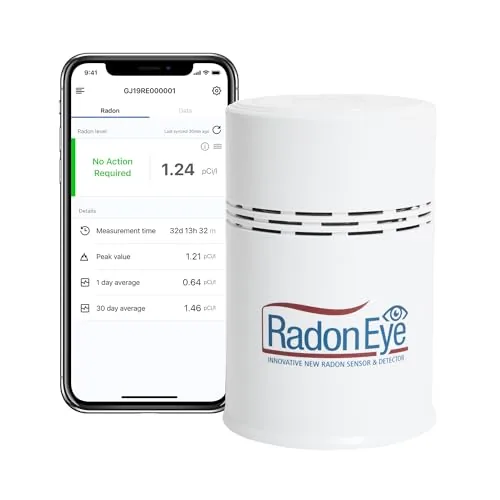
Why we picked it: In the Canadian National Radon Proficiency Program (C-NRPP)‘s 2024/25 chamber comparison, the RadonEye earned an A grade (measurement error of 10% or less) in all four 7-day chamber rounds, which ran from about 210 to 1,200 Bq/m³ (roughly 5.7 to 32 pCi/L) in winter-like and summer-like conditions; that’s not a guarantee for every reading or home. Bob Vila named it the best long-term monitor: Bob Vila’s test unit gave a first reading in 10 minutes, paired quickly with its app, and over a 30-day test showed updates every 10 minutes plus peak, daily and monthly averages. The listing describes an ion chamber sensor, an OLED display, Bluetooth app and a 12-month limited warranty. It had 2,111 ratings at our check, sold by Ecosense Inc.
Best for: a basement or main living area with an outlet, where you want both a screen and app history. Who this is NOT for: crawl spaces or rooms without an outlet; it plugs in. It also connects over Bluetooth, so you check the app near the device rather than remotely.
Limitation: the 10-minute first reading isn’t a finished radon test; follow EPA and C-NRPP guidance on test length before deciding to fix your home. The Canadian test units weren’t matched to this US listing.
2. Airthings Corentium Home 223 Radon Detector

Why we picked it: The Corentium Home also earned an A grade in all four rounds of the Canadian National Radon Proficiency Program (C-NRPP) comparison, and Bob Vila chose it as its best overall radon test: readings started in under 24 hours, and the screen shows both short- and long-term averages. Bob Vila reports that owners can generate a free self-inspection report on Airthings’ website after monitoring for at least 30 days. C-NRPP’s table lists a first reading after 24 hours. The listing says it’s the US version, reads in pCi/L and runs on three AAA batteries. It had 10,804 ratings at our check, sold by Amazon.com.
Best for: anyone who wants a simple battery monitor with no phone needed, placed where EPA recommends (see below). Who this is NOT for: anyone who wants graphs or phone alerts; it has no app.
Limitation: you wait about a day for the first number, and early readings swing more than long-term averages. If an early reading is high, don’t ignore it: follow EPA’s follow-up steps below. The C-NRPP test named the Corentium Home without matching units to this US listing.
3. Aranet Radon Plus Radon Detector
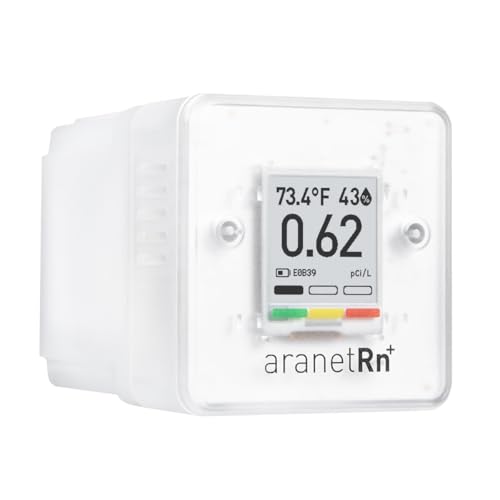
- RESULTS IN MINUTES: Patented ultra-low-power architecture for maximum efficiency – the only truly portable radon monitor…
- BATTERY POWERED: Digital radon detector with up to 7-year lifetime using 2 AA batteries.
- COMPREHENSIVE ENVIRONMENTAL MONITORING: This radon gas detector also measures temperature, relative humidity, and atmosp…
Why we picked it: C-NRPP’s 2024/25 report lists an Aranet RN+, which earned A grades in all four rounds of the Canadian National Radon Proficiency Program (C-NRPP)‘s comparison; we couldn’t confirm that it’s the same version as this US Radon Plus listing. The listing describes a battery-powered monitor that measures every 10 minutes, runs up to 7 years on 2 AA batteries, shows real-time and 24-hour, 7-day or 30-day averages on a color-coded E-Ink screen in pCi/L or Bq/m³, also tracks temperature, humidity and air pressure, and works standalone or with an app. It had 296 ratings at our check, sold by ARANET USA.
Best for: data-minded owners who want long battery life and averages by period. Who this is NOT for: buyers on a budget; it’s the priciest monitor here at our check.
Limitation: C-NRPP’s tested units weren’t matched to this US listing. It isn’t covered by the hands-on reviews cited here.
4. Ecosense EcoBlu EB100 Radon Detector

- FAST AND ACCURATE : First reading in 10 minutes with patented ion chamber radon sensor technology
- EASY TO USE : Simple plug and play
- FULL SIZE DIGITAL DISPLAY : Compact design for easy reading from a distance
Why we picked it: The EcoBlu is on the Canadian National Radon Proficiency Program (C-NRPP)‘s current approved list of consumer monitors, which lists the maker’s stated accuracy of ±14% at 370 Bq/m³ after 10 hours, a first reading after 10 minutes, and real-time, daily, weekly, monthly and yearly averages on an LED display with no app. The listing describes it as plug-and-play with an ion chamber sensor and a 12-month limited warranty. It had 743 ratings at our check, sold by Ecosense Inc.
Best for: anyone who wants a readable on-device display with no app setup. Who this is NOT for: anyone who wants app history or alerts on a phone.
Limitation: the listing warns that running it from a portable battery may affect accuracy, so use the included adapter. Its maker-stated accuracy (±14%) is wider than the RadonEye’s maker-stated ±10% on the same C-NRPP table; both are manufacturer specifications, not chamber results.
5. Airthings Corentium Home 2 (Model 325) Radon Detector

Why we picked it: the updated Corentium Home adds Bluetooth and an app with radon graphs, plus temperature and humidity sensors, while keeping a battery-powered design and an on-device display of short- and long-term averages, according to the listing. It had 484 ratings at our check, sold by Amazon.com.
Best for: anyone who likes the original Corentium’s battery design but wants app graphs. Who this is NOT for: buyers who want model-specific independent results; see the limitation.
Limitation: the listing says it has the same accuracy as the original, but the C-NRPP and Bob Vila results above cover the original Corentium Home, not this model 325, and it isn’t covered by the reviews cited here.
6. Ecosense EcoQube Flex EF100 Radon Detector
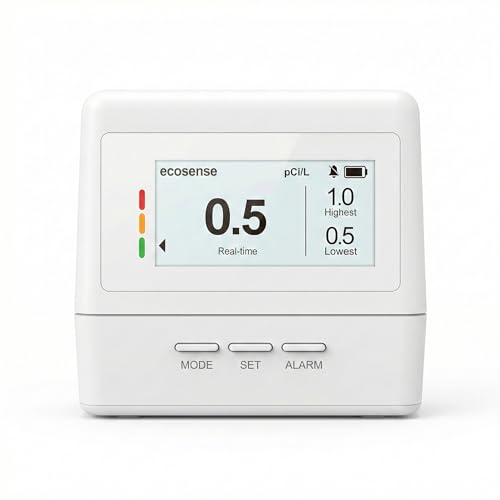
Why we picked it: The EcoQube Flex is on the Canadian National Radon Proficiency Program (C-NRPP)‘s current approved list, which describes 10-minute readings with a first result after 10 minutes, real-time through yearly averages plus highs and lows on an E-Ink display and Bluetooth app, and battery power. The listing describes an ion chamber sensor and a cord-free design that doesn’t need an outlet. It had 69 ratings at our check, sold by Ecosense Inc.
Best for: a lived-in room without a handy outlet, if you want Ecosense’s fast first reading. Who this is NOT for: anyone who wants a model with many owner ratings; it had 69 at our check.
Limitation: the listing suggests moving it room to room to find hotspots, but for a real test leave it in one place for the full test period. It isn’t covered by the hands-on reviews cited here.
7. First Alert RD1 Radon Test Kit

- The simple and safe way to test for radon
- Listed under the EPA radon gas measurement proficiency program
- Includes test materials and lab fees, excluding NJ state fees
Why we picked it: Bob Vila named it the best value radon test. It’s a one-time charcoal kit you leave out for 2 to 4 days and mail to a lab; their testers found it easy to use, and results came back by email quickly. Bob Vila stresses two rules from the instructions: don’t leave the kit out for more than 7 days, and it must reach the lab within 10 days of testing. The listing says lab fees are included (excluding New Jersey state fees) and that it’s for use in the United States. It had 10,328 ratings at our check, sold by Amazon.com.
Best for: a first short-term check, or a second short-term test as EPA describes. Who this is NOT for: anyone who wants ongoing readings; it’s a single short-term test.
Limitation: one short test can’t show your year-round average, and a result of 4 pCi/L or more needs a follow-up test. Follow the kit’s instructions closely: EPA says to keep windows and outside doors closed during short-term tests (starting at least 12 hours before a 2- to 3-day test) and to avoid testing during severe storms or high winds.
Where to Place a Radon Detector
The short answer: on the lowest floor you actually live on, in a regularly used room, at least 20 inches off the floor.
- Lowest lived-in level. EPA’s Citizen’s Guide to Radon says to test in the lowest lived-in level of the home: the basement if it’s used often, otherwise the first floor.
- A room you use. A living room, playroom, den or bedroom, but not a kitchen or bathroom. C-NRPP says a room occupied at least 4 hours a day.
- Height and position. EPA says at least 20 inches above the floor, where it won’t be disturbed, away from drafts, high heat, high humidity and exterior walls.
- If the result is 4 pCi/L or higher. EPA’s guide says to follow up with a long-term test or a second short-term test; if the first short-term result is more than twice the 4 pCi/L action level, take a second short-term test immediately. Fix your home if a long-term result is 4 pCi/L or more, and consider fixing if the average of two short-term tests is 4 pCi/L or higher.
A high reading means fix the house, not just the detector. If your long-term result is 4 pCi/L or higher, EPA says to fix your home. Contact a qualified radon mitigation professional; your state radon program can help you find one.
Related Guides
Frequently Asked Questions
What is the most accurate home radon detector?
We can’t name one most accurate model, but in the Canadian National Radon Proficiency Program’s 2024/25 chamber comparison, the Ecosense RadonEye, Airthings Corentium Home and Aranet RN+ each earned an A grade (10% or less measurement error) in all four 7-day test rounds. That’s a controlled test, not a guarantee for every unit or home.
What radon level is dangerous?
EPA says there’s no known safe level of radon. Its action level is 4 pCi/L: fix your home at 4 pCi/L or higher, and consider fixing between 2 and 4 pCi/L.
How long should I test for radon?
Short-term tests last 2 to 90 days and long-term tests longer, according to EPA. C-NRPP recommends leaving a digital monitor in place for at least 3 months, preferably during the heating season.
Are digital radon detectors as good as a lab test?
Good ones can track your level continuously, but Canada’s C-NRPP says consumer monitors can’t be professionally calibrated and aren’t approved for professional use. For a home sale, follow your state’s rules and EPA’s testing steps, or hire a certified radon professional.
Where should I put a radon detector?
EPA says the lowest lived-in level of the home, in a regularly used room (not a kitchen or bathroom), at least 20 inches above the floor and away from drafts, heat, humidity and exterior walls.
The Bottom Line
For ongoing monitoring, start with the plug-in Ecosense RadonEye RD200 or the battery-powered Airthings Corentium Home, both A-graded in every round of C-NRPP’s chamber comparison. Choose the Aranet Radon Plus for detailed averages and long battery life, the EcoBlu for a simple display with no app, and the EcoQube Flex or Corentium Home 2 if you want a battery model with an app. For a low-cost short-term check, mail in a First Alert RD1. Test the lowest lived-in floor, follow up on any result of 4 pCi/L or more, and fix the house if EPA’s steps say to.