Disclosure: This guide contains affiliate links. If you buy through them, BunyanSafe may earn a commission at no extra cost to you.
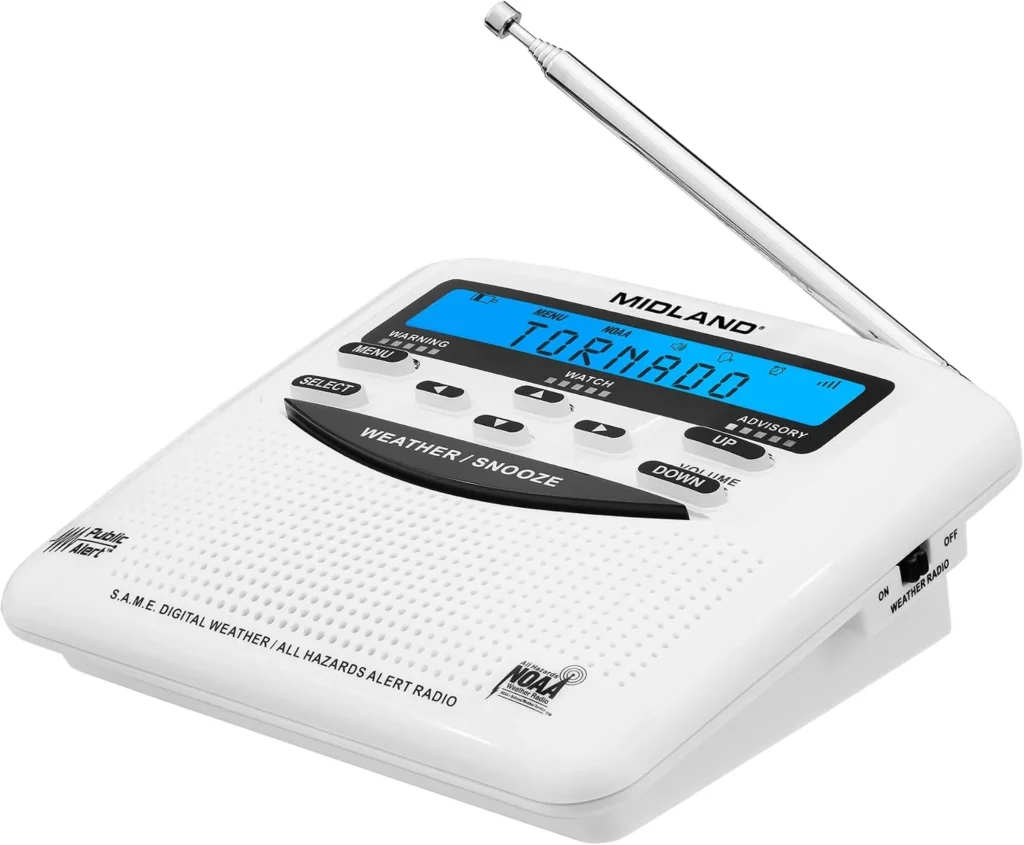
The best weather radio for most homes is a desktop NOAA weather alert radio with SAME county programming and an alert alarm, because a compatible, correctly set-up receiver can sound an alarm for a tornado or flood warning at night even with the broadcast audio off. A hand-crank emergency radio is a different tool: it keeps you informed during a power outage, but many can’t sound an alarm on their own. This guide explains that difference, then compares seven weather radios across both types.
How we picked: we read each Amazon listing, checked stock and ratings on Amazon (US, ZIP 10001) in October 2026, and sorted the radios by the alert features the National Weather Service describes. We have not tested reception or alerts. Treat every feature below as a listing claim to check on the exact model.
Quick picks
- Our pick for most homes: Midland WR120B, a desktop alert radio with SAME programming for up to 25 counties.
- Desktop alert radio with more alert options: Midland WR400, with siren, voice and flashing alerts plus a clock.
- Lower-priced desktop alert radio: RunningSnail SAME weather radio, up to 23 county codes.
- Portable radio that lists Public Alert: Sangean MMR-99, hand crank, solar and USB-C.
- Hand-crank radio with an alert mode: Raynic 5000mAh emergency radio.
- Hand-crank radio from Midland: Midland ER310.
- Lowest-priced crank radio: FosPower A1, for listening during outages.
Compare the seven weather radios
| Radio | Type | SAME (per listing) | Alert (per listing) | Price tier |
|---|---|---|---|---|
| Midland WR120B | Desktop | Yes, 25 counties | Yes, selectable tone | Mid-range |
| Midland WR400 | Desktop | Yes, 25 counties | Siren, voice, flashing | Premium |
| RunningSnail | Desktop | Yes, 23 counties | Voice, siren, visual | Budget |
| Sangean MMR-99 | Portable, crank | Not stated | Lists Public Alert | Premium |
| Raynic 5000mAh | Portable, crank | Not stated | Auto-scan alert | Budget |
| Midland ER310 | Portable, crank | Not stated | “Weather Scan + Alert” (title) | Premium |
| FosPower A1 | Portable, crank | Not stated | Not stated | Budget |
What makes a weather radio different from a regular radio?
Short answer: it can receive NOAA Weather Radio, which broadcasts on seven VHF frequencies that a normal AM/FM radio can’t pick up. The best ones can also sound an alarm when a warning is issued for your county.
Per the National Weather Service’s NOAA Weather Radio receiver guide:
- The broadcast: NOAA Weather Radio All Hazards is a network of more than 1,000 transmitters broadcasting warnings, watches and forecasts 24 hours a day on 162.400 to 162.550 MHz. It also carries non-weather hazard alerts.
- Tone alarm: the NWS sends a 1050 Hz tone before most warnings and many watches. Radios equipped to receive it switch on even with the audio off, which the NWS says is especially useful at night.
- SAME: Specific Area Message Encoding lets you program your county, so the radio responds only to alerts for the areas you choose, instead of every county your transmitter covers.
- Public Alert logo: the NWS recommends looking for receivers with the Public Alert or NOAA Weather Radio All Hazards logo. Public Alert devices meet a Consumer Technology Association standard (CTA-2009-C).
The NWS also notes that if you want to be alerted day or night, a standalone weather radio might work best, while a multi-band radio suits people who just want to tune in.
Alert radio or emergency crank radio: which do you need?
Short answer: for warnings at night, get a desktop alert radio with SAME. For power outages, add a crank or solar radio. The two types complement each other, as long as you check reception, alert settings and backup power.
- Desktop alert radio (Midland WR120B, WR400, RunningSnail): sits by your bed and sounds an alert for the counties you programmed. The WR400 and RunningSnail listings mention battery backup; check the WR120B manual for its power options.
- Emergency crank radio (Sangean, Raynic, Midland ER310, FosPower): power options vary by model, from hand crank and solar to rechargeable or replaceable batteries, and most add a flashlight. Alert features vary a lot, so check the listing.
1. Midland WR120B: our pick for most homes
Bottom line: a desktop NOAA weather alert radio with SAME programming that, per the listing, lets you set up to 25 counties and be alerted only when those counties are threatened. It covers more than 60 kinds of hazards and has a selectable alert tone.

- NOAA Weather Scan & Alert – This emergency weather alert radio features S.A.M.E localized programming and alert you to o…
- S.A.M.E Localized Programming – The Specific Area Message Encoding (S.A.M.E.) allows the user to enter a code that is sp…
- Notification Settings – Program your radio to receive weather alerts from up to 25 different counties and be alerted onl…
The listing describes color-coded alert indicators, an always-on backlight option and alert override that switches the radio to a warning. It had more than 24,000 ratings when we checked on October 10, 2026, the most of the desktop picks.
Limitation: SAME setup means entering location codes by following the manual. It’s a desktop radio, not something to carry outside.
Who this is NOT for: anyone who mainly needs a radio for camping or long outages. A crank radio fits that better.
2. Midland WR400: desktop alert radio with more alert options
Bottom line: Midland’s deluxe desktop alert radio, with SAME for up to 25 counties, 80 alert types and a choice of an 85 dB siren, voice alert or flashing lights, per the listing. It also has an alarm clock, AM/FM and a USB port to charge a phone.

- NOAA Weather Scan + Alert: NOAA Weather Scan will automatically scan through 10 available weather (WX) band channels and…
- S.A.M.E Programming: Improve your emergency preparedness with equipped with digital S.A.M.E. technology, weather radio s…
- Warning System: Experience customizable alert options with the WR400 Warning System. You have the flexibility to choose …
The listing says it scans the weather band channels and locks onto the strongest one, and that it has battery backup. It had more than 4,600 ratings when we checked.
Limitation: it’s in the premium tier, and the extra features aren’t needed if the WR120B covers you.
Who this is NOT for: buyers on a budget who only need the alarm. The WR120B and RunningSnail cost less when we checked.
3. RunningSnail SAME weather radio: lower-priced desktop alert radio
Bottom line: a desktop SAME radio that, per the listing, supports up to 23 county codes, all seven NOAA channels, and voice, siren or visual alerts, with battery backup. It was the lowest-priced desktop alert radio here when we checked on October 10, 2026.

- [Hyper-Local Emergency Alerts] Utilizes S.A.M.E. (Specific Area Message Encoding) technology to deliver targeted alerts….
- [24/7 NOAA All-Hazards Radio Monitoring] Access continuous, authoritative alerts for storms, wildfires, and multi-hazard…
- [Customizable Alert System] This noaa weather radio with alerts personalizes notifications through voice, siren, or visu…
The listing lists more than 80 alert types and modes for all, multiple or single counties, and its title mentions an external antenna; check what’s included.
Limitation: it had about 2,000 ratings at 4.2 stars when we checked, fewer than Midland’s desktop radios.
Who this is NOT for: buyers who want the most-reviewed option. The Midland WR120B has far more ratings.
4. Sangean MMR-99: portable radio that lists Public Alert
Bottom line: a rugged handheld radio with hand crank, solar and USB-C charging, a 2600mAh battery, and seven NOAA channels with Public Alert, per the listing. Public Alert is the CTA standard the NWS recommends looking for.

- 𝗠𝘂𝗹𝘁𝗶-𝗣𝗼𝘄𝗲𝗿 𝗥𝗲𝗹𝗶𝗮𝗯𝗶𝗹𝗶𝘁𝘆: Stay connected with 3 power options: hand crank, solar panel, and USB-C. Features a built-in 26…
- 𝗘𝗺𝗲𝗿𝗴𝗲𝗻𝗰𝘆 𝗥𝗲𝗮𝗱𝘆: Receive vital alerts with 7 NOAA Weather Channels and Public Alert. Includes a powerful, adjustable LED…
- 𝗩𝗲𝗿𝘀𝗮𝘁𝗶𝗹𝗲 𝗔𝘂𝗱𝗶𝗼: Enjoy AM/FM-RBDS digital tuning with 45 presets, plus seamless Bluetooth streaming for your music. Feat…
The listing also describes an IP55 rating, an SOS flashlight with a red night light, Bluetooth, and a USB-A port to charge small devices.
Limitation: it had the highest card price of these seven when we checked on October 10, 2026, and about 280 ratings. The listing doesn’t say whether it supports SAME county programming.
Who this is NOT for: anyone who only needs a bedside alarm. A desktop alert radio costs less for that job.
5. Raynic 5000mAh emergency radio: hand-crank radio with an alert mode
Bottom line: a solar and hand-crank radio with AM, FM, shortwave and NOAA bands, a 5000mAh battery that can charge a phone, and a flashlight and SOS siren, per the listing. The listing says it auto-scans for alerts when it’s on or in standby.

It lists six ways to charge, including a built-in rechargeable battery. It had more than 20,000 ratings when we checked.
Limitation: the listing doesn’t mention SAME, so it may sound for alerts outside your county. Check how standby affects battery life. We hid this card’s bullets because one says it “may save your life,” which we can’t verify.
Who this is NOT for: anyone who wants county-specific alerts at the bedside. Choose a SAME desktop radio.
6. Midland ER310: hand-crank radio from Midland
Bottom line: Midland’s emergency crank radio with AM/FM and NOAA weather bands, multiple power sources, an SOS flashlight and an ultrasonic dog whistle, per its title, which also lists “NOAA Weather Scan + Alert.”
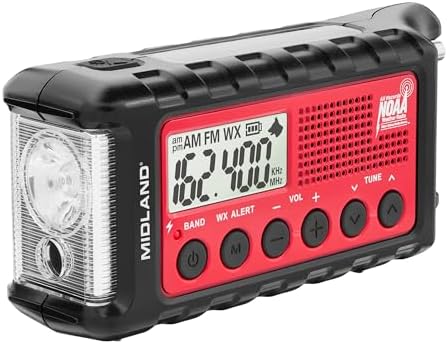
The listing’s feature bullets were essentially blank when we checked, so we’re relying on the title. It had about 6,000 ratings.
Limitation: with almost no bullets, check the manual or Midland’s product page for alert and battery details. We hid this card’s bullets because they were empty.
Who this is NOT for: buyers who want full specs on the listing before they buy.
7. FosPower A1: lowest-priced crank radio (at our check)
Bottom line: a hand-crank and solar radio with AM/FM and NOAA weather band, AAA battery backup, a 2000mAh power bank, a flashlight, a reading light and an SOS alarm, per the listing. We’d treat it as a radio for listening during an outage.
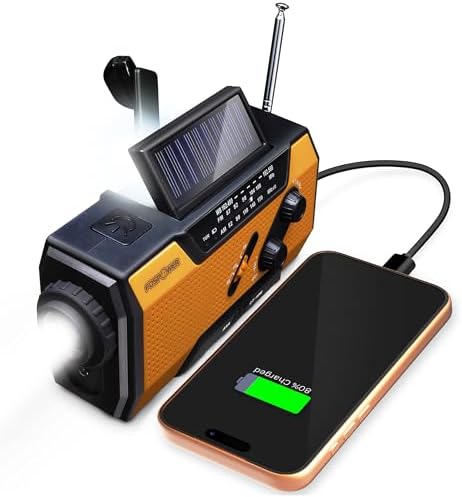
- [7400mWh (2000mAh) POWER BANK WILL KEEP DEVICES POWERED] The FosPower FOSPWB-2376 emergency radio incorporates a 7400mWh…
- [3 POWER SOURCES POWER WHEN YOU NEED IT] Use the emergency weather radio’s 3 power sources when you need a boost of powe…
- [2 LIGHT SOURCES ALWAYS POWERED] The emergency crank radio can also provide light. The 4 LED reading light and 1W flashl…
It had nearly 38,000 ratings when we checked, the most of all seven, and the lowest card price.
Limitation: the listing confirms NOAA reception but doesn’t state automatic weather alerts or SAME, so don’t rely on it for unattended warnings without checking the manual. Its SOS alarm is a siren for signaling, not a weather alert.
Who this is NOT for: anyone counting on the radio to warn them at night.
How to set up a weather radio
- Find your station and county code. The NWS has a station finder and county code lists on its NOAA Weather Radio pages.
- Program SAME for the areas you need alerts for, using official codes and your radio’s instructions.
- Put it where you’ll hear it, usually a bedroom, and keep batteries in it for outages.
- Know how your radio shows the weekly test. The NWS runs routine tests; check your manual and the NWS receiver notes for how your model indicates one, rather than assuming it must sound an alarm.
Black Friday tip: a weather radio is a practical gift for someone in tornado, hurricane or winter storm country. US Bing search estimates for “weather radio” peaked in March and April 2026 (about 3,480 and 3,240), the highest months in the past year of data, while October 2025 was about 960. Check the current price on the listing.
Frequently asked questions
Do I need a weather radio if I get alerts on my phone?
A phone is a good first layer, but it depends on cell service, battery and settings. A weather radio receives the NWS broadcast directly, and a compatible, correctly set-up alert radio can sound an alarm even with the broadcast audio off.
What does SAME mean on a weather radio?
Specific Area Message Encoding. Per the NWS, it lets the radio respond only to alerts for the counties you program, rather than every county your transmitter covers.
Can a regular radio pick up NOAA weather broadcasts?
No. The NWS says NOAA Weather Radio broadcasts can’t be heard on a simple AM/FM radio. You need a radio with the weather band.
Where should I put a weather radio?
Somewhere you’ll hear it at night, like a bedroom, and where it gets good reception. Some radios have an external antenna jack if reception is weak.
The bottom line
For warnings at night, the Midland WR120B is the weather radio we’d start with: SAME county programming and listing-described weather alerts. For outages, add a crank radio like the Raynic or Sangean MMR-99, and remember that a basic crank radio like the FosPower A1 is for listening, not for alerts.
A weather radio belongs in a broader plan. See our home emergency kit guide, our portable power station guide for longer outages, and our carbon monoxide detector guide before you run any backup heat or generator.