Disclosure: This guide contains affiliate links. If you buy through them, BunyanSafe may earn a commission at no extra cost to you.
The best fire extinguisher for home use is a multipurpose A-B-C extinguisher with a UL listing, sized so the person most likely to grab it can actually lift and aim it. The numbers on the label, like 1-A:10-B:C or 3-A:40-B:C, tell you how much fire it can handle. This guide decodes those numbers, compares eight home fire extinguishers by room, and covers the most important part: when to use one and when to just get out.
How we picked: we compared each Amazon listing’s fire rating and certification claim, agent weight, valve type and rechargeability, noting where a listing leaves something out, checked stock on Amazon (US, ZIP 10001) in October 2026, and used the U.S. Fire Administration’s guidance on choosing and using extinguishers. We have not fire-tested these units. Treat every rating below as a listing claim to confirm on the label of the exact model you buy.
Safety first: a home extinguisher is for a small fire that’s contained to one object, like a pan or a wastebasket. If the fire is spreading, the room is filling with smoke, or you’re unsure, get everyone out and call 911. Your smoke alarms and an escape plan matter more than any extinguisher.
Quick picks by room and job
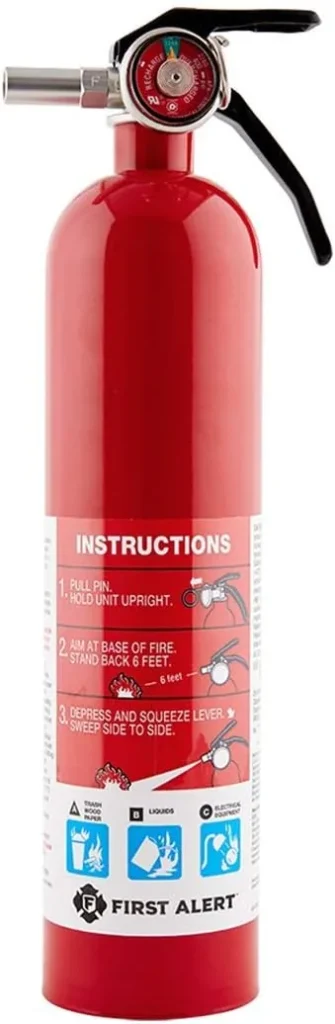
- Our pick for most homes: First Alert HOME1, UL rated 1-A:10-B:C, metal valve, rechargeable.
- Best budget extinguisher: Kidde Basic 110 (FA110G), UL rated 1-A:10-B:C, 2.5 lb.
- Best for living areas: Kidde Living Area (KD143-210ABC), 2-A:10-B:C, 4 lb.
- Best for garages and large homes: Kidde Full Home (KD176-340ABC), 3-A:40-B:C, 5.5 lb.
- Best rechargeable 2-A unit: First Alert HOME2PRO, UL rated 2-A:10-B:C.
- Best 5 lb commercial-style unit: Amerex B500, 5 lb ABC dry chemical, aluminum valve.
- Best for the kitchen: Kidde Kitchen (711A), for small cooking oil and grease fires.
- Best backup spray: First Alert EZ Fire Spray, an aerosol to keep alongside a rated extinguisher.
Compare the eight fire extinguishers
| Extinguisher | Rating (per listing) | Size | Refill | Price tier |
|---|---|---|---|---|
| First Alert HOME1 | UL 1-A:10-B:C | Standard home | Rechargeable | Budget |
| Kidde Basic 110 | UL 1-A:10-B:C | 2.5 lb agent | Single use | Budget |
| Kidde Living Area | 2-A:10-B:C | 4 lb agent | Single use | Mid-range |
| Kidde Full Home | 3-A:40-B:C | 5.5 lb agent | Single use | See listing |
| First Alert HOME2PRO | UL 2-A:10-B:C | Heavy duty | Rechargeable | Mid-range |
| Amerex B500 | ABC (see label) | 5 lb agent | Not stated | Premium |
| Kidde Kitchen 711A | Grease fires (see label) | 2.5 lb agent | Single use | Budget |
| First Alert EZ Fire Spray | ETL (aerosol) | Spray can | Not stated | Budget |
What do the numbers on a fire extinguisher mean?
Short answer: the letters tell you which kinds of fire it’s for, and the numbers tell you how much. A higher number in front of A or B means more firefighting capacity.
Per the U.S. Fire Administration’s guide to choosing and using fire extinguishers:
- Class A: ordinary materials like cloth, wood and paper. The number before the A is a multiple of 1.25 gallons of water, so 1-A equals about 1.25 gallons and 2-A about 2.5 gallons.
- Class B: flammable liquids like grease, gasoline, oil and oil-based paint. The number before the B is the square footage of fire it can put out, so 10-B is up to 10 square feet and 40-B up to 40.
- Class C: energized electrical equipment. A C rating means the agent doesn’t conduct electricity, so it’s suitable for plugged-in equipment. It has no number.
USFA says a multipurpose “A-B-C” extinguisher covers most types of home fires, that you should look for a “UL Listed” or “ULC Listed” label, and that you should choose the largest extinguisher you can safely and comfortably operate.
When should you use a fire extinguisher at home?
Short answer: only when the answer to every question below is yes, you know how to use your extinguisher, and it’s the right type for the fire. Otherwise, leave and call 911.
USFA’s checklist, in short:
- Have you alerted everyone in the home, and has someone called the fire department?
- Are you physically able to use an extinguisher? USFA says young children and older adults should not use them.
- Is the fire small and contained to one object or surface, like a pan or a wastebasket?
- Are you safe from the smoke?
- Do you have a clear way out? Keep it behind you as you face the fire.
If the fire doesn’t go out quickly, or the smoke or heat gets worse, stop and get out.
Then remember PASS: Pull the pin while holding the extinguisher with the nozzle pointing away from you, Aim low at the base of the fire, Squeeze the lever slowly and evenly, and Sweep from side to side. Follow the instructions on your model’s label, too. USFA also suggests asking your local fire department about hands-on training.
1. First Alert HOME1: best overall for most homes
Bottom line: a UL-rated 1-A:10-B:C multipurpose extinguisher with an all-metal body, a commercial-grade metal valve and trigger, and a metal gauge, per the listing. Unlike the Kidde Basic 110 in this guide, it can be recharged by a certified professional after use.

- First Alert’s HOME1 FE1A10GR Fire Extinguisher is UL rated 1-A: 10-B:C; it features durable all-metal construction with …
- Multipurpose fire extinguisher fights wood, paper, trash, plastics, gasoline, oil, and electrical-equipment fires
- First Alert’s Rechargeable Fire Extinguisher can be recharged by a certified professional after use, allowing for reuse.
The listing says it’s for wood, paper, trash, plastics, gasoline, oil and electrical fires, and that it’s U.S. Coast Guard approved for marine use. It had more than 39,000 ratings when we checked on October 10, 2026, the most of our picks.
Limitation: 1-A:10-B:C is the lowest A rating among the models here with a listed number. USFA’s advice is to pick the largest size you can safely handle, so consider a 2-A unit if everyone at home can manage it.
Who this is NOT for: anyone who wants a higher-capacity unit for a garage or workshop. The Kidde Full Home or First Alert HOME2PRO carry higher ratings, though the same rule applies: only small, contained fires.
2. Kidde Basic 110 (FA110G): best budget extinguisher
Bottom line: a compact, UL-listed 1-A:10-B:C extinguisher with 2.5 pounds of dry chemical, an aluminum body and a pressure indicator, per the listing. It’s a low-cost way to put one on every floor.

- Reliable Fire Protection: Stop basic home fires involving trash, wood, paper, liquids, gases, and electrical equipment
- All-Metal Construction: Made with robust materials for long-lasting durability
- Easy pull safety pin
The listing calls it residential and single use, with a 6-year limited warranty. It had more than 30,000 ratings when we checked on October 10, 2026.
Limitation: it’s single use, so once you discharge it, even briefly, replace it. Its 1-A:10-B:C rating is the lowest listed A rating here.
Who this is NOT for: anyone who wants a rechargeable unit. The First Alert HOME1 can be professionally recharged.
3. Kidde Living Area (KD143-210ABC): best for living areas
Bottom line: a 2-A:10-B:C extinguisher with 4 pounds of dry chemical, a metal valve assembly, a pressure gauge and a wall hanger, per the listing. It roughly doubles the Class A capacity of the 1-A units above.

- Reliable Fire Protection: Stop basic home fires including trash, wood, paper, liquids, gases, and electrical equipment
- 2X More Firefighting Power: Combat common household fires with a 12-year service free design
- All-Metal Construction: Metal valve assembly, rust, and impact-resistant handle & easy pull safety pin
The listing gives a 13 to 15 second discharge time and a 12 to 18 foot range, and describes a 12-year service-free design; you should still check the gauge and condition regularly. A listed 13 to 15 seconds isn’t long, which is why aiming at the base of the fire matters.
Limitation: it holds more agent than the 2.5 lb units, so the full unit is heavier, and it’s single use.
Who this is NOT for: anyone who finds the full unit hard to lift and aim. A lighter 1-A unit they can use is better than a bigger one they can’t.
4. Kidde Full Home (KD176-340ABC): best for garages and large homes
Bottom line: the highest listed fire rating here at 3-A:40-B:C, with 5.5 pounds of dry chemical, per the listing. The higher B number covers larger flammable-liquid fires, which is why it suits a garage where gasoline and oil are stored.

- Reliable Fire Protection: Stop basic home fires involving trash, wood, paper, liquids, gases, and electrical equipment
- 3X More Firefighting Power: Combat common household fires with a 12-year service free design
- All-Metal Construction: Metal valve assembly, rust, and impact-resistant handle & easy pull safety pin
Like the Living Area model, it has a metal valve assembly, a pressure gauge, a 13 to 15 second discharge and a wall hanger, per the listing.
Limitation: it holds the most agent of the Kidde units here, so it’s the heaviest to handle, and it’s single use. The card didn’t show a price when we checked on October 10, 2026; see the listing.
Who this is NOT for: anyone who can’t comfortably lift and aim the full unit. Check the total weight on the listing before you buy.
5. First Alert HOME2PRO: best rechargeable 2-A unit
Bottom line: a UL-rated 2-A:10-B:C extinguisher with an all-metal body, a commercial-grade metal valve and trigger, and a wall hook, per the listing. It’s rechargeable by certified professionals after use.

- The First Alert HOME2PRO Fire Extinguisher is UL rated 2-A: 10-B:C and meets minimum 2-A: 10-B:C code requirements; It f…
- Heavy-duty fire extinguisher fights wood, paper, trash, plastics, gasoline, oil, and electrical-equipment fires; ideal f…
- Uses mono ammonium phosphate extinguishing agent; Rechargeable by certified professionals after use
The listing says it meets minimum 2-A:10-B:C code requirements and suits homes, offices and workshops. It uses monoammonium phosphate, a common A-B-C dry chemical, and carries a 12-year limited warranty.
Limitation: recharging means finding a certified service company, which costs time and money.
Who this is NOT for: people who’d rather replace than recharge. The Kidde Living Area has the same 2-A:10-B:C rating as a single-use unit.
6. Amerex B500: best 5 lb commercial-style unit
Bottom line: a 5-pound ABC dry chemical extinguisher with an all-metal aluminum valve and a wall bracket, per the listing. It holds more agent than the 2.5 lb home units.

- ABC Dry Chemical, Class A:B:C Extinguisher
- For use on Class A (ordinary combustibles), Class B (Flammable liquid) spills or Fires involving live electrical equipme…
- 14 sec. discharge time
The listing gives a 14-second discharge time and covers Class A, B and C fires. Its bullets don’t print the exact UL rating or say whether it can be recharged, so check the label and manufacturer details.
Limitation: it had the highest card price among our picks with a displayed price on October 10, 2026, and 5 pounds of agent makes it a heavier unit to handle.
Who this is NOT for: anyone who needs a light extinguisher, or who wants the rating printed up front. Choose a 2.5 lb unit with a listed rating instead.
7. Kidde Kitchen (711A): best for the kitchen
Bottom line: a residential extinguisher with 2.5 pounds of agent, made for small cooking oil and grease fires in home kitchens, with a flared nozzle that the listing says reduces oil splashing.

- Reliable Fire Protection: Stop tough grease fires
- Kitchen Fire Extinguisher: A flared nozzle reduces oil splashing
- All-Metal Construction: metal valve assembly, rust, and impact-resistant handle & easy pull safety pin
It has a metal valve assembly, a pressure indicator and a wall hanger, per the listing. It’s residential and single use.
Limitation: its bullets don’t print the UL rating, so check the label. For a small pan fire on the stove, if you can act safely, slide a lid over the pan and turn off the burner, don’t move the pan, and leave it covered until it’s completely cool. Never use water on a grease fire. If you’re unsure, get out and call 911.
Who this is NOT for: rooms without cooking. Use an A-B-C unit for the rest of the house. Mount it where you can reach it on your way out of the kitchen, not right beside or behind the stove.
8. First Alert EZ Fire Spray: best backup spray
Bottom line: an aerosol can that the listing says puts out paper, fabric, wood, grease and electrical fires. It’s light and easy to grab. The listing names ETL certification but doesn’t give an A-B-C numerical rating, so keep it alongside a rated extinguisher, not instead of one.

The listing says it sprays for 32 seconds and suggests it for kitchens, garages, boats, RVs and dorms. It had about 12,700 ratings when we checked on October 10, 2026.
Limitation: USFA’s advice is to look for a UL or ULC listed extinguisher, and this listing names ETL instead. We hid this card’s bullets because one compares its spray time to “a traditional fire extinguisher” without saying which.
Who this is NOT for: anyone looking for their only extinguisher. Buy a rated A-B-C unit first.
How many fire extinguishers do you need at home?
One planning example is an extinguisher on every floor, with the kitchen and garage covered (the kitchen unit can be your floor’s unit). Mount each one near an exit, so you’re moving toward a way out when you grab it, and somewhere everyone in the home knows about. Your local fire department can advise on placement.
How to maintain a home fire extinguisher
USFA suggests checking that nothing blocks access, the gauge shows the right pressure, the can, hose and nozzle aren’t damaged or rusted, and the outside is clean. It also notes that some extinguishers need to be shaken monthly and others pressure tested every few years, and that some can be recharged while others must be replaced. Follow the label on yours.
Black Friday tip: a fire extinguisher is a practical housewarming or holiday gift. US Bing search estimates for “fire extinguisher for home” rose from about 1,750 in October 2025 to 2,310 in November and 2,460 in December 2025. Check the current price on the listing.
Frequently asked questions
What type of fire extinguisher is best for home use?
USFA says a multipurpose A-B-C extinguisher can be used on most types of home fires. Look for a UL or ULC listed label and choose the largest size you can safely handle.
What does 1-A:10-B:C mean?
Per USFA, it’s the equivalent of 1.25 gallons of water on ordinary-materials fires (1-A), it can put out flammable-liquid fires up to 10 square feet (10-B), and its agent doesn’t conduct electricity, so it’s suitable for energized electrical equipment (C).
Can you use a regular fire extinguisher on a grease fire?
Not as your first choice. For a small stovetop grease fire, if it’s safe, slide a lid over the pan and turn off the burner, and don’t move the pan. If you use an extinguisher, use one listed for cooking-oil fires, like the Kidde 711A, and follow its label; a strong blast from a general-purpose unit can splash burning oil. USFA describes a separate type for commercial kitchens with cooking oils and fats. If you’re unsure, get out and call 911.
Do fire extinguishers expire?
Follow the label and manufacturer guidance for your model. The Kidde Living Area and Full Home listings describe a 12-year service-free design, but you should still check the gauge and condition regularly, and single-use units must be replaced after any discharge.
The bottom line
For most homes, the First Alert HOME1 is the extinguisher we’d start with: UL rated 1-A:10-B:C, metal valve and rechargeable. Add a Kidde Full Home for the garage and a Kidde Kitchen mounted near the kitchen exit, and remember that getting out and calling 911 always comes first.
Fire safety works best as a system. See our guides to the best smoke detectors, carbon monoxide detectors and space heater safety, and keep important papers in a fire-resistant safe.